Usage & Context
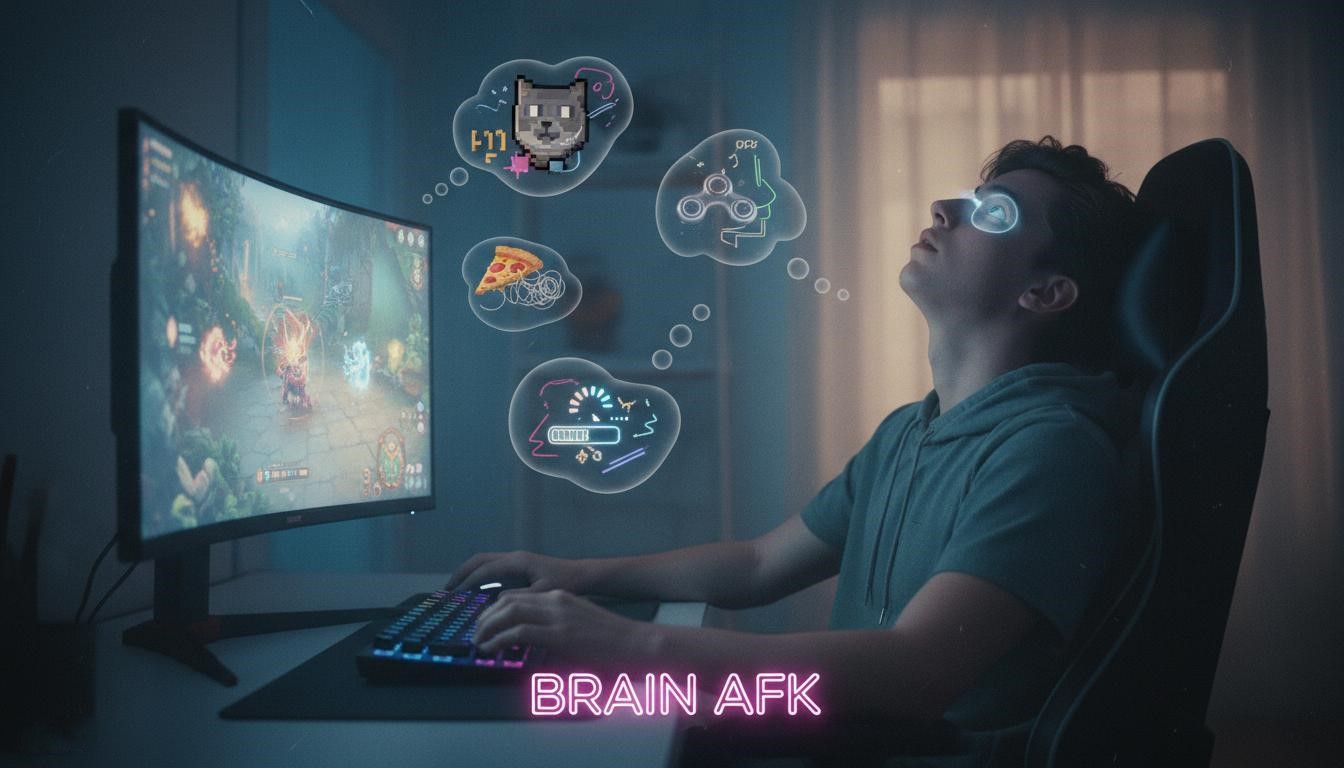
Brain AFK borrows the gaming term “AFK” (Away From Keyboard) and applies it to your own consciousness. It describes that state where your body is physically present — sitting in class, scrolling TikTok, nodding along in a conversation — but your mind has completely logged off. The term exploded in 2026 as Gen Z embraced increasingly frank language about mental fatigue and dissociation, wrapping it in internet vocabulary that feels casual rather than clinical.
On TikTok, “brain AFK” shows up in captions about zoning out during lectures, staring at walls after work, or losing entire hours to sludge content. The hashtag has tens of millions of views, with strongest adoption among Gen Z (ages 16–28), students, and remote workers. The term peaked in January–June 2026 and remains in active use.
GEBILAOWANG’s take: this term resonates because it captures a universal experience with precision — everyone knows what it feels like to have your brain go offline, and giving it a name makes it feel normal rather than broken. The internet wrapper makes it accessible to younger users who might not engage with clinical mental health vocabulary.
Conversation: “Sorry, I was brain AFK for a sec. What did you say?”
TikTok Caption: “Me going brain AFK while my professor explains the same thing for the 5th time”
Text: “I’ve been brain AFK since 2pm”
POV: “you’re brain AFK but your body is still at the party”
Origin Story
The term evolved from gaming culture where “AFK” has been standard vocabulary for decades. It crossed into everyday language in late 2025 when creators started using “brain AFK” to describe zoning out during streams, and went fully mainstream in early 2026 when lifestyle and mental health creators adopted it as shorthand for dissociation and mental fatigue.
The gaming origins are what make the term land so well. “AFK” is universally understood in online spaces — it means someone is physically present but mentally absent. Applying that same logic to your own brain creates an instant, intuitive metaphor. Unlike clinical terms like “dissociation” which can feel heavy, “brain AFK” feels light, relatable, and distinctly internet-native.
Cultural Significance
“Brain AFK” represents a broader linguistic shift where Gen Z uses technical/digital metaphors to describe mental states. Rather than saying “I’m tired” or “I spaced out,” the gaming frame provides a more precise, less stigmatized way to communicate mental unavailability. The term has been particularly adopted by neurodivergent communities on TikTok as a way to describe executive dysfunction or attention drift without medicalizing the experience.
This pattern — using gaming/internet vocabulary to describe real-life mental states — is becoming increasingly common. “Brain AFK,” “404 coded,” “glitching” — all borrow from tech culture to give name to experiences that previously lacked casual vocabulary. In 2026, being able to say “my brain is AFK” carries less stigma than saying “I’m dissociating,” even when describing the same experience. That linguistic reframing matters.
Related Slang
- Zoning out — the older, more generic version
- Dissociating — more clinical, sometimes used seriously
- Mental checkout — similar but less catchy
- Autopilot mode — more functional, implies still performing tasks
Frequently Asked Questions
What does “brain AFK” mean?
It means your mind has checked out — you’re physically present but mentally offline. Borrowed from gaming where “AFK” means Away From Keyboard.
Is “brain AFK” about mental health?
It can be, but it’s usually casual. Most people use it for normal fatigue or boredom, not clinical dissociation. Context matters.
What’s the difference between “brain AFK” and “zoning out”?
It’s the gaming-native upgrade of “zoning out.” Zoning out is vague; brain AFK specifically implies your mind has logged off like a player leaving their keyboard — more precise and more internet-culture-coded.
Can I use it at work or school?
With peers, absolutely. With professors or bosses, maybe stick to “I lost focus for a moment.”
Pronunciation
/breɪn eɪ ɛf keɪ/
Sources
- Know Your Meme — “Brain AFK” https://knowyourmeme.com/memes/brain-afk
- TikTok Creative Center — Trending Keywords & Hashtags Dashboard https://ads.tiktok.com/business/en-US/solutions/tiktok-creative-center