Usage & Context
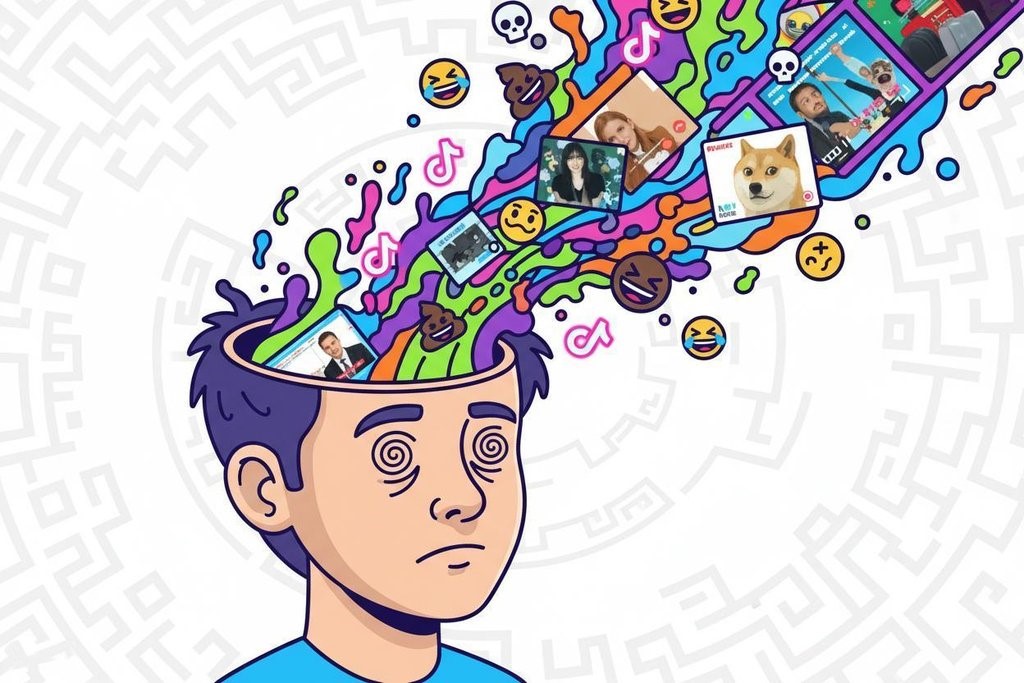
“Brain rot” is a 2023-2026 slang term describing the mental fog and cognitive decline from consuming too much low-value, repetitive online content. Named Oxford Word of the Year 2024, it was officially recognized by Merriam-Webster in April 2026 and Dictionary.com in November 2024.
On TikTok, “brain rot” shows up in self-deprecating captions about falling down algorithm rabbit holes — “me watching 3 hours of satisfying slime videos at 2am knowing full well I have work in 5 hours. The brain rot is real.” The hashtag #brainrot has billions of views, with content ranging from confessional videos to ironic compilations of the most mind-numbing content categories (subway surfers gameplay, soap cutting, AI-generated voices reading Reddit posts).
The term functions as both a self-diagnosis (“I have brain rot”) and a critique of content culture (“this app gives me brain rot”). It’s primarily used by Gen Z (ages 16–28) globally, with strongest adoption in the US, UK, and Australia. Unlike fleeting TikTok slang, “brain rot” names a genuine cultural anxiety that isn’t going away as long as short-form content dominates attention spans.
TikTok Caption: “Me watching 3 hours of ‘satisfying slime’ videos at 2am knowing full well I have work in 5 hours. The brain rot is real.”
Group Chat: “Friend: Did you see that 47-part story someone posted about their grocery trip? / Me: I’ve got active brain rot and I still wouldn’t watch that.”
Tweet: “Just spent 20 minutes watching a man review different brands of bottled water. My brain rot has reached terminal levels.”
Origin Story
The term “brain rot” has a surprisingly long history for internet slang. It first appeared in Henry David Thoreau’s 1854 book Walden, where he used it to critique how modern media (newspapers, in his era) was degrading people’s mental capacity. The phrase lay dormant for over 150 years until it was resurrected on TikTok in 2023, where users began self-diagnosing their own mental fog after hours of scrolling.
The meaning had shifted slightly — Thoreau was critiquing intellectual laziness; modern “brain rot” describes the actual cognitive fatigue from information overload. The viral explosion came in two waves. First, Oxford Languages named “brain rot” the 2024 Word of the Year, citing a 230% increase in usage frequency. Then in April 2026, Merriam-Webster officially added it to their dictionary, defining it as: “the supposed deterioration of a person’s mental or intellectual state, especially viewed as the result of overconsumption of material (now particularly online content) considered to be trivial or unchallenging.”
Cultural Significance
The power of “brain rot” lies in its self-awareness. Unlike clinical terms like “attention deficit” or “cognitive overload,” “brain rot” is casual, almost humorous — it lets people acknowledge their screen addiction without the heaviness of a medical diagnosis. It’s the linguistic equivalent of laughing at yourself for watching 47 TikToks in a row at 2am.
GEBILAOWANG’s take: what’s fascinating about “brain rot” is its journey from 19th-century literary critique to 21st-century self-deprecating humor. The term has essentially been redefined by the very medium it critiques — TikTok users diagnosing themselves with “brain rot” while continuing to scroll is peak internet irony. The fact that it earned institutional recognition (Oxford WOTY, Merriam-Webster) in under two years shows how quickly internet-driven linguistic anxiety can enter mainstream vocabulary.
The term also reflects a broader generational anxiety about attention spans and cognitive health. As short-form content becomes the dominant media format, concerns about its impact on memory, focus, and critical thinking have moved from academic discussions into everyday conversation. “Brain rot” gives that anxiety a name — and naming it makes it feel manageable, even funny.
Related Slang
- Doom scrolling — compulsively consuming negative news, a common cause of brain rot
- Sludge content — low-quality, algorithm-optimized content designed to keep you scrolling
- Touch grass — the antidote to brain rot; a reminder to disconnect and experience reality
- Brain AFK — temporary mental checkout (brain rot is the chronic condition)
Frequently Asked Questions
What does “brain rot” mean?
It’s the mental fog and cognitive decline from consuming too much low-quality online content — that fried, foggy feeling after hours of scrolling TikTok or watching mindless videos.
Where did “brain rot” come from?
It first appeared in Henry David Thoreau’s 1854 book Walden, lay dormant for 150+ years, then was resurrected on TikTok in 2023. Oxford named it Word of the Year 2024.
Is “brain rot” a real medical condition?
No — it’s casual self-deprecating slang, not a clinical diagnosis. However, psychologists do study the cognitive effects of excessive screen time and short-form content consumption.
Is “brain rot” here to stay?
With Oxford WOTY status and Merriam-Webster recognition, it has serious institutional staying power. It names a genuine cultural anxiety that will persist as long as short-form content dominates.
Pronunciation
/breɪn rɒt/
Sources
- Merriam-Webster — “Brain Rot” Official Definition https://www.merriam-webster.com/dictionary/brain%20rot
- Oxford Languages — Word of the Year 2024 https://languages.oup.com/word-of-the-year/2024/