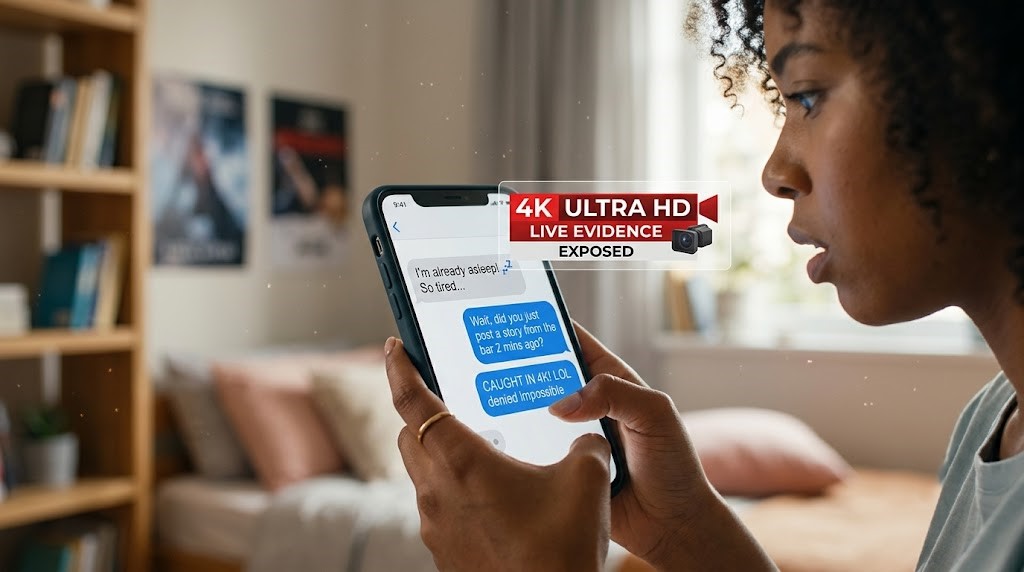
Caught in 4k is what happens when you get exposed with evidence so clear that denying it would be insulting to everyone’s intelligence. The “4k” refers to ultra-high-definition video resolution, and the phrase implies that whatever you did was captured with that level of clarity. There’s no ambiguity. There’s no “taken out of context.” There’s just you, on camera, doing exactly what you’re accused of doing.
I first saw this phrase on Twitter around 2019, but it became a TikTok staple by 2020. Someone would post a screenshot of a text conversation where the other person contradicted themselves, and the caption would be “caught in 4k.” The humor was in the courtroom energy applied to completely mundane situations.
Where caught in 4k came from
The phrase started in gaming and tech communities where “4k” was already familiar as a resolution standard. Around 2019, Twitter users started using it metaphorically. “Caught in 4k” meant not just caught, but caught with evidence so clear it could be broadcast in ultra-HD.
TikTok adopted the phrase around 2020 and added visual elements. Creators would post videos with a “4k” graphic overlay, like a news broadcast graphic, whenever they caught someone in a lie or embarrassing moment. The format became standardized: setup, reveal, “caught in 4k” graphic, reaction.
By 2021, the phrase had expanded beyond TikTok into general internet vocabulary. It became the go-to response to any form of public hypocrisy. Politician contradicts their previous statement? Caught in 4k. Celebrity gets photographed doing something they denied? Caught in 4k. Your friend claims they didn’t eat your leftovers but there’s a photo of them holding the empty container? Caught in 4k.
How people actually use it
On TikTok, the usage is almost always humorous. The phrase gets applied to situations that are nowhere near 4k quality. A blurry screenshot of a text conversation. A low-resolution photo from a party. The joke is in the exaggeration. Calling a pixelated screenshot “4k” is inherently funny because it’s the opposite of accurate.
The phrase also gets used in comments sections. Someone posts a video of their ex doing something they claimed they never did, and the comments are just “caught in 4k” repeated hundreds of times. The spam is half the point. It’s the internet’s way of forming a unanimous jury.
The phrase has even spawned sub-variations. “Caught in 720p” means the evidence is decent but not definitive. “Caught in 144p” means it’s blurry but still probably true. “Caught in 8k” means the evidence is so clear it’s almost uncomfortable. The resolution metaphor scales perfectly.
In gaming, it’s used when someone gets caught cheating or lying about their rank. The evidence is usually a screen recording or replay file. “Bro got caught in 4k using wall hacks” means there’s video proof that’s impossible to deny.
The phrase has also evolved into a reaction image format. Screenshots of obvious contradictions get posted with “4k” watermarks, turning ordinary Twitter exchanges into crime scene investigations. The visual language of the meme, with its news broadcast graphics and dramatic zooms, has become as recognizable as the phrase itself.
Caught in 4k vs exposed: what’s the actual difference?
“Exposed” is general. It just means someone found out. “Caught in 4k” is specific. It means there’s evidence, and the evidence is clear, and the evidence is public. The 4k part adds a layer of technological precision that makes the exposure feel more definitive.
The phrase also carries a different tone. “Exposed” can be serious or funny. “Caught in 4k” is almost always funny, even when the underlying situation is serious. The humor comes from the dramatic framing of ordinary evidence as cinematic proof.
On TikTok, the two terms get used for different contexts. “Exposed” is for drama and serious allegations. “Caught in 4k” is for petty contradictions, obvious lies, and relatable embarrassments. The 4k version is less threatening and more memeable.
Why it stuck around
The phrase works because it combines tech literacy with courtroom drama in a way that makes every minor exposure feel like a cinematic event, and everyone knows what 4k means, and everyone understands the concept of being caught, so putting them together creates a phrase that feels both modern and timeless while also being instantly understandable to anyone who has ever seen a screenshot.
TikTok’s visual format also helped. The “4k” graphic overlay became a recognizable meme template. Creators could apply it to any video, instantly upgrading a mundane moment to a cinematic expose. The template made the phrase more versatile than text-based insults.
Honestly? I think the phrase will stick around because it’s adaptable. As long as people keep getting caught doing things they shouldn’t, there will be a need for a phrase that captures the clarity of the evidence. “Caught in 4k” does that with style.
The phrase also benefits from being universally applicable across contexts. It works for celebrity scandals, relationship drama, workplace slip-ups, and gaming controversies. Unlike niche slang that dies when its subculture moves on, “caught in 4k” describes a fundamental human experience: getting exposed with proof. That universality gives it staying power that trendier phrases lack.
Related slang
- main character syndrome — The self-focus that often leads to getting caught in 4k
- chud — The type of person who frequently gets caught in 4k
- sigma male — An archetype that supposedly never gets caught in 4k
- aura farming — Performing coolness, which can backfire into getting caught in 4k