Usage & Context
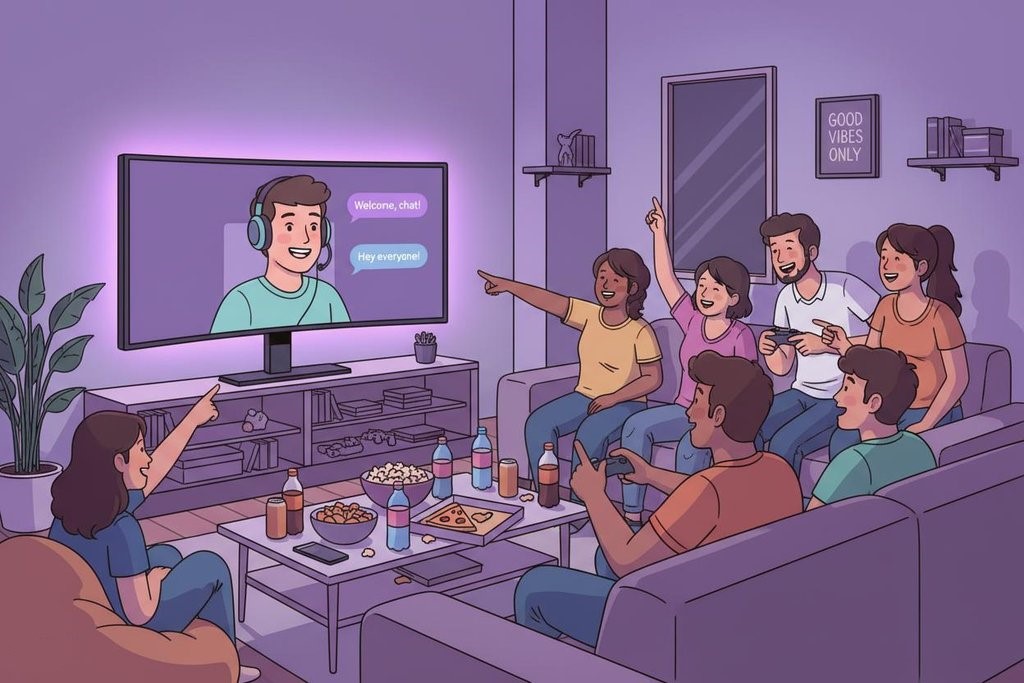
“Chat” is a 2025-2026 slang term of address borrowed from livestreaming culture, used to refer to a group of people as if they were a livestream audience. Originally the name for Twitch’s live comment section, it has escaped into everyday Gen Z conversation as a replacement for “guys,” “everyone,” or “dude.”
On TikTok and in group chats, you’ll hear “Chat, should I text him back?” or “Chat, did you see what just happened?” The term carries a specific performative energy — it frames the conversation as a broadcast with an audience. It’s primarily used by Gen Z (ages 13–22), especially those who grew up watching Twitch streamers and YouTubers. The term is gender-neutral, casual, and distinctly internet-native.
The Gabb Teen Slang Dictionary formally recognized “chat” in its June 2026 edition, defining it as: “Used to refer to a group of people, like friends or people in their class.” Mashable’s June 2026 internet slang guide noted that “chat” had “escaped livestreaming culture and entered everyday internet language.”
Group Chat: “Chat, should I text him back or wait? / Friend: Chat, you already know the answer / Me: Chat, I’m cooked either way 😭”
Classroom Whisper: “Chat, did you see what Mr. Henderson just wrote on the board? I think he gave up on us.”
TikTok Caption: “Chat, I tried to cook dinner and now my kitchen looks like a crime scene. Rate my disaster 1-10.”
Origin Story
The slang use of “chat” originated on Twitch, where streamers have always addressed their live audience as “chat” — short for “chat room,” the scrolling comment section where viewers interact in real time. Phrases like “Hey chat, what should I do next?” or “Chat, did you see that?” have been staples of streaming vocabulary since the platform’s early days.
What changed in 2025 was the migration: young viewers who grew up watching streamers began using “chat” ironically in everyday conversation, addressing their friends as if they were a livestream audience. By 2026, the irony had worn off and “chat” became a genuine term of address. Parents.com even ran an article titled “Why Kids Are Calling Each Other ‘Chat’” in June 2025, documenting how tweens and teens were using the term as a replacement for names or traditional greetings.
Cultural Significance
The rise of “chat” reflects a fundamental shift in how Gen Z conceptualizes social interaction. For this generation, every moment has the potential to be content — a mindset where you’re always performing for an invisible audience. “Chat” captures this mentality perfectly: it turns every conversation into a livestream, every group of friends into an audience, every decision into content.
GEBILAOWANG’s take: what’s fascinating about “chat” is that it represents the complete fusion of online and offline identity. Previous generations had “online friends” and “real friends” as separate categories; Gen Z doesn’t make that distinction. When a teenager says “Chat, are we cooked?” to their friends at lunch, they’re not pretending to be a streamer — they’re expressing how they genuinely experience reality, as a perpetual broadcast. The term also demonstrates how quickly streaming culture has become the dominant linguistic influence for Gen Z, surpassing even music and television as the primary engine of slang creation.
Related Slang
- Guys — the traditional collective address; “chat” is replacing it as a gender-neutral alternative
- Everyone — more formal; “chat” feels more casual and internet-native
- Dude / Bro — gendered alternatives that “chat” avoids
- No cap / For real — other streaming-origin phrases that entered everyday speech
- Fam — another casual group address, though more intimate than “chat”
Frequently Asked Questions
What does “chat” mean as slang?
It’s a gender-neutral way to address a group of people, like saying “hey guys” or “everyone.” It comes from Twitch, where streamers call their audience “chat.”
Where did “chat” come from?
It originated on Twitch’s live comment section (the “chat room”). Streamers addressed viewers as “chat,” and Gen Z adopted it into everyday conversation by 2025-2026.
Is “chat” offensive?
Very unlikely — it’s harmless and playful. The only context where it might feel odd is in professional settings where it sounds extremely casual.
Is “chat” here to stay?
With coverage from Mashable, Parents.com, and the Gabb Teen Slang Dictionary, it’s clearly in its rising phase. It fills the need for a gender-neutral, casual collective term that “guys” (gendered) and “everyone” (too formal) don’t quite satisfy.
Pronunciation
/tʃæt/
Sources
- Mashable — Chat, are we cooked? A guide to internet slang in 2026 https://in.mashable.com/digital-culture/111064/chat-are-we-cooked-a-guide-to-internet-slang-in-2026
- Yahoo Entertainment — Chat, are we cooked? A guide to internet slang in 2026 https://www.yahoo.com/entertainment/articles/chat-cooked-guide-internet-slang-090000553.html