Usage & Context
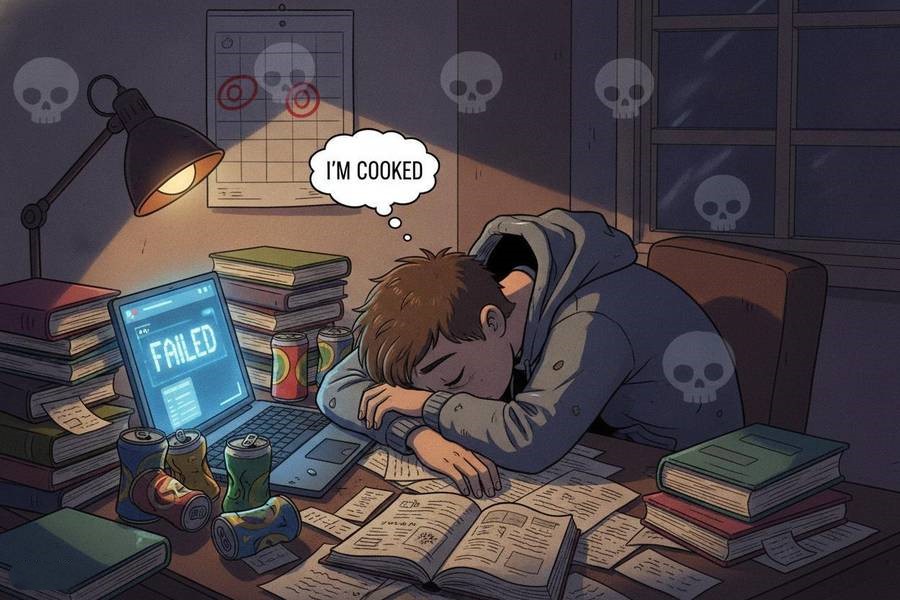
“Cooked” is the word you use when the situation is so bad that being upset about it would require too much energy. On TikTok, it shows up in comment sections under fail videos, chaotic news clips, and those “things that didn’t age well” compilations. Someone posts about their three finals in one day, the replies are just “you’re cooked 💀” in unison. It’s not even an insult — it’s a diagnosis. The situation has been assessed and the verdict is that there is no recovery.
The emoji pairings tell you everything about the tone. “Cooked 💀” is the standard — dark humor, acknowledging the absurdity. “Cooked 😭” adds genuine distress underneath the joke. “Cooked 🔥” is ironic, like when something is so catastrophically bad it becomes impressive. The word itself is flexible but the tone is always this specific blend of resignation and humor. You’re not angry, you’re not sad — you’re just cooked.
What’s made it so sticky is how it works for both self-deprecation and roasting others. “I’m cooked” after forgetting an essay deadline hits different than “he’s cooked” when someone posts their own L. Both are funny, both are relatable, and both get engagement. The dual usage makes it twice as versatile as most slang terms, which tend to work better in one direction.
TikTok Comment: “Three finals on the same day??? You’re genuinely cooked bro, no recovery from that 💀”
Group Chat: “Tyler: Just found out the presentation is TODAY not Friday / Jess: lmaooo you are so cooked / Tyler: i know 😭 i have nothing / Jess: godspeed king”
Twitter/X Post: “Opened my bank account after the weekend. Yeah I’m cooked.”
Origin Story
The slang use of “cooked” has roots in Black American vernacular and hip-hop, where the metaphor of being “done” like overcooked meat has existed for decades. The gaming community picked it up around 2019-2020 — Twitch streamers started saying “he’s cooked” when a player was about to lose, and the phrase spread through Discord servers and gaming forums.
TikTok took it mainstream between 2021 and 2023. Reaction video creators used “cooked” as a caption for fail compilations and chaotic content. The algorithm favored it because it’s short, punchy, and works as both text overlay and comment. By 2024, it had crossed into everyday texting, Instagram captions, and even UK slang circles — which is notable because most American slang doesn’t translate across the Atlantic this cleanly.
The term’s peak cultural moment came in 2025-2026 when “cooked” became the default response to any bad news. Exam season posts, work drama, relationship fails, political chaos — everything was “cooked.” The word’s flexibility let it absorb new meanings without losing its core identity. Whether describing personal exhaustion or societal collapse, “cooked” somehow fits.
Cultural Significance
“Cooked” works because it reflects how Gen Z processes stress and failure. Instead of performative hustle culture (“rise and grind”) or toxic positivity (“everything happens for a reason”), “cooked” is just honest. The situation is bad. There might not be a solution. Laughing about it is sometimes the only option left. That emotional honesty is what makes the term resonate so deeply.
The word also captures something about the speed of modern life that older slang couldn’t. Things go from fine to cooked so fast now — a notification, a text, a sudden realization. The term’s brevity matches the experience. You don’t have time for a full sentence about how overwhelmed you are. “I’m cooked” communicates the entire emotional state in two words and two syllables.
GEBILAOWANG’s take: The genius of “cooked” is that it’s fundamentally cooperative rather than competitive. When you tell someone they’re cooked, you’re not putting them down — you’re joining them in acknowledging a bad situation. Even when it’s self-directed (“I’m cooked”), it invites solidarity. That collectivity is rare in slang, which tends to be more about status and exclusion. In 2026, when everyone’s feeling some degree of overwhelmed, “cooked” creates connection through shared resignation.
Related Slang
- Done — neutral, just finished; lacks the hopelessness of “cooked”
- Toast — retro 90s sitcom energy, more playful than “cooked”
- Burned — specifically about social embarrassment
- Washed — describes decline over time, not a sudden collapse
- Over — dramatic and final, but without the dark humor
Frequently Asked Questions
What does “cooked” mean in slang?
“Cooked” means you’re completely done for, overwhelmed, or in a hopeless situation with no way out. It can describe exhaustion, failure, or chaos, usually with a mix of dark humor and resignation.
Where did “cooked” come from?
It originated in Black American vernacular and hip-hop culture, spread through gaming communities around 2019-2020, and went viral on TikTok between 2021-2023. By 2025-2026 it had become mainstream Gen Z vocabulary.
Is “cooked” offensive?
Not at all. It’s one of the most inoffensive slang terms in current use. The only edge case is using it toward someone who’s genuinely distressed — it might feel cold if the tone is wrong. Context matters.
What’s the difference between “cooked” and “toast”?
Both mean you’re in trouble, but “toast” feels retro and playful — 90s sitcom energy. “Cooked” is more current, more Gen Z, and lands heavier. If you’re under 25 in 2026, you’re saying “cooked,” not “toast.”
Can “cooked” mean tired?
Yes, but modern usage leans more toward “done for” in a broader sense — not just physically tired, but mentally overwhelmed, in a bad situation, or facing consequences. It’s more dramatic than just being sleepy.
Pronunciation
/kʊkt/
Sources
- SlangPedia — Cooked Meaning Slang: What It Really Means in 2026 https://slangpedia.co.uk/cooked-meaning-slang/
- MeaningsOrbit — Cooked Slang Meaning in 2026 https://meaningsorbit.com/cooked-slang-meaning/
- Similessons — Cooked Meaning Slang (2026 Guide) https://similessons.com/cooked-meaning-slang/