Usage & Context
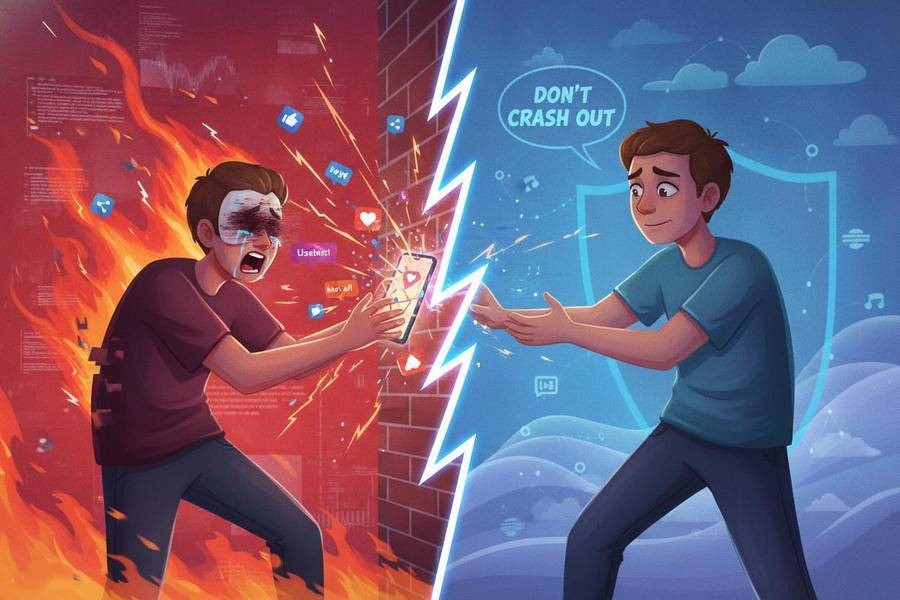
“Crash out” hits different from other emotional slang because it’s specifically about the public nature of the breakdown. You don’t crash out in private. You crash out when everyone’s watching. On TikTok, you’ll see it in comment sections under drama videos — “she’s about to crash out live” — or as a warning between friends — “don’t crash out over this, it’s not worth it.” The term carries this built-in sense of spectacle, like you’re witnessing someone’s composure literally crumble in real time.
The phrase works across emotional registers too. It can describe anything from a full public meltdown (arguing in comment threads, posting then deleting, going live while upset) to more subtle self-sabotage (sending that text you know you shouldn’t, subtweeting your ex, oversharing personal drama). The common thread is impulsivity + visibility + consequences. If there’s no audience and no fallout, you didn’t crash out — you just had a bad moment.
Gaming culture gave the term its original skeleton. “He crashed out” started as streamer slang for someone raging so hard they ruined their own game. TikTok borrowed that framing and applied it to emotional situations. Now it’s equally at home describing someone who sent a risky 2am text as someone who threw their controller through a wall. The versatility is what makes it stick.
The warning signs are usually obvious in hindsight. Someone who’s about to crash out tends to escalate fast — a minor disagreement becomes a full argument, a small frustration spirals into a public vent session. The digital paper trail makes it worse because everything is permanent. You can’t unsend a tweet or un-post a TikTok. The crash out becomes part of your internet history, screenshot and saved by people who were just watching for entertainment.
In 2026, crashing out isn’t even that scandalous anymore — it’s more like “yeah, they crashed out, we’ve all been there.” The bar for what counts as a dramatic public meltdown has been raised by how much wild behavior people see daily. That doesn’t make it less damaging for the person doing it, though. The internet has a long memory even when the audience has a short attention span.
TikTok Comment: “She saw the subtweet and immediately crashed out in the replies 💀”
Group Chat: “Dude: My ex just posted a new relationship announcement / Friend: Do NOT crash out bro, stay strong / Dude: Too late, I already commented 👍”
Twitter/X Post: “Watching someone crash out in real time on main is my favorite free entertainment ngl”
Origin Story
The slang version of “crash out” emerged from two parallel tracks. The literal meaning — falling asleep suddenly — had been around forever. The gaming adaptation — someone raging so hard they “crashed out” of the game mentally — started picking up steam around 2020-2021 on Twitch and in Discord servers. Streamers would use it to describe teammates who lost their composure and started making terrible plays out of frustration.
TikTok grabbed the gaming version and generalized it. By 2024, creators were using “crash out” to describe any public emotional meltdown, not just gaming rage. The phrase worked because it captured the specific combination of loss of control + visible consequences that defines so much social media drama. Drama accounts and commentary creators adopted it quickly because it was more vivid than saying “they got upset” or “they overreacted.”
The term went fully mainstream in 2025 when several high-profile influencer dramas got described as “crash outs” in real time — creators going live while emotional, posting then deleting frantic stories, subtweeting each other in public. The live, unfiltered nature of these meltdowns made “crash out” feel like the perfect description. By 2026, it had become standard vocabulary across platforms.
Cultural Significance
“Crash out” captures something essential about how emotions work in the social media age. Before TikTok, having a meltdown was mostly private. Maybe your friends saw it, maybe you embarrassed yourself at a party. Now, crashing out means potentially thousands of strangers watching your worst moment, archiving it, making it into content. The term exists because the experience it’s describing didn’t really exist at scale before.
The phrase also reflects Gen Z’s genuinely conflicted relationship with emotional expression. On one hand, there’s huge cultural pressure to be open about mental health, to be authentic, to not suppress feelings. On the other hand, crashing out is universally understood as bad — losing control, making yourself vulnerable, giving people ammunition. “Crash out” sits right in that tension. It acknowledges that emotional honesty is good while emotional impulsivity is risky, and the difference between them can be a matter of seconds or a single post.
GEBILAOWANG’s take: What’s interesting about “crash out” is that it’s not purely judgmental like some slang. When someone says “don’t crash out,” there’s often genuine concern mixed with the teasing. The culture recognizes that crashing out feels necessary in the moment even when it’s clearly a bad idea. That empathy underneath the mockery is what separates this term from more purely insulting slang. In 2026, we’ve all either crashed out ourselves or watched someone we care about do it — the shared experience makes the language less cruel than it could be.
Related Slang
- Rage quit — gaming-specific, when anger makes you leave; “crash out” is broader
- Spiral — slower emotional descent; “crash out” is sudden and public
- Meltdown — more clinical, less slangy
- Send it — impulsive but usually positive; “crash out” is impulsive and negative
- Main character syndrome — can lead to crashing out when reality doesn’t cooperate
Frequently Asked Questions
What does “crash out” mean?
“Crash out” means losing emotional control and reacting impulsively or irrationally, usually in a public or visible way. It describes everything from public meltdowns to self-sabotaging behavior driven by strong emotions.
Is “crash out” the same as having a mental breakdown?
Not clinically. “Crash out” describes a visible emotional overreaction or impulsive behavior, not a diagnosable mental health episode. It’s about behavior others can observe, not internal psychological states.
Can “crash out” be used jokingly?
Yes, especially among friends. “Don’t crash out” can be a light warning when someone’s getting worked up about something minor. The tone determines whether it’s genuine concern or playful teasing.
Where did “crash out” come from?
It evolved from gaming/streaming culture where it described someone raging so hard they mentally “crashed out” of the game. TikTok generalized it to describe any public emotional meltdown, and it went mainstream around 2025.
Is crashing out always bad?
Mostly yes, because it usually involves impulsive decisions with real consequences. But the culture around it has become more empathetic — “crashing out” is understood as something that happens to everyone sometimes, not just a moral failing.
Pronunciation
/kræʃ aʊt/
Sources
- MeanFix — Super Crash Out Meaning Slang: What It Really Means in Text & Online in 2026 https://meanfix.com/crash-out-meaning-slang/
- English Colege — Fein Meaning Slang in 2026 (includes crash out in related slang) https://englishcolege.com/fein-meaning-slang-in-2026/