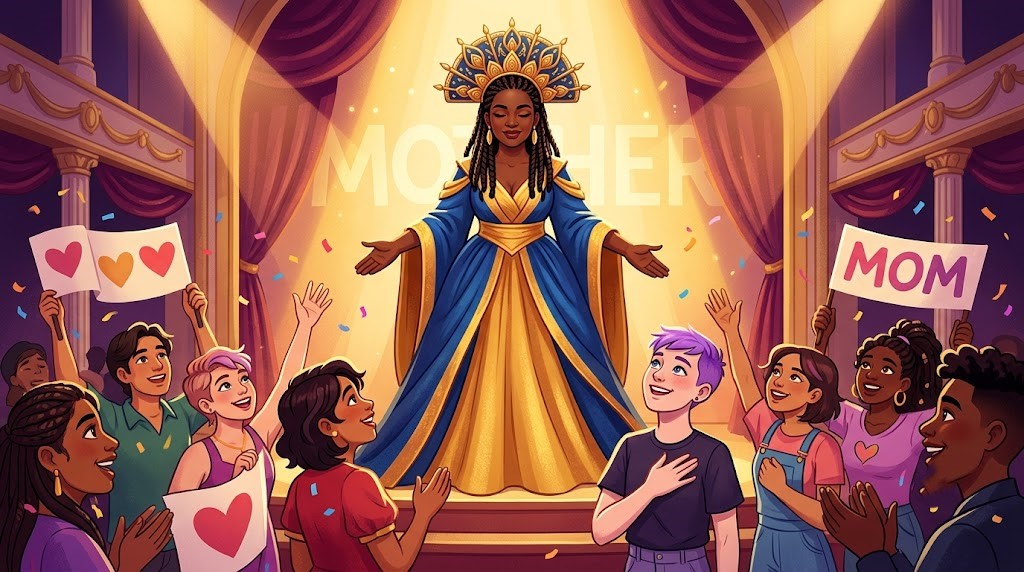
“Mother is mothering” is the internet’s way of crowning a woman for being powerful and nurturing at the same time. You drop it under a clip of Beyoncé checking on a fan mid-show, or Zendaya hyping her whole cast, and it means she’s providing. Emotionally, spiritually, sometimes literally.
I first watched it flood in back in 2023, when Rihanna showed up as a judge at the House of Miyake-Mugler’s 30th anniversary ball and my entire feed was “mother has arrived” for about a week. I caught it again last month under a Zendaya press-tour clip. Same word, same energy.
Older than TikTok. Way older.
In queer slang, a mother is a maternal figure who takes queer and trans young people under her wing. Sometimes that’s personal: a bed, hot meals, guidance. Sometimes it’s generational, a pop star who serves as a model of possibility for kids who don’t see themselves anywhere else. Penn State scholar Ariana Steele describes queer mothers as extending the role of biological mothers, “always being there when you need them.”
And this goes back centuries. Like, candlelight centuries.
- 1720s, London: Margaret Clap, a straight woman, ran one of the best-known molly-houses (gathering spots for gay men and gender-nonconforming people) out of her own home. Patrons called her “Mother Clap.”
- 1880s, America: William Dorsey Swann, born into slavery, organized some of the earliest known drag pageants in the country.
- 1960s: Crystal LaBeija and Lottie LaBeija, fed up with racism in drag pageants, founded one of the first ballroom houses, taking in young queer and trans people who needed family and direction.
- 1991: Paris is Burning put that scene on film. Decades later, FX’s Pose carried the ballroom house structure to a mainstream TV audience.
Then the pop girls got hold of it. Lady Gaga’s rise around 2008 came with “Mother Monster.” Meghan Trainor dropped a single literally called “Mother” in 2022, pushed again in 2023. RuPaul released “Call Me Mother.” By then the word had fully jumped fences: open any Beyoncé, Taylor Swift, or Zendaya post and the replies are “Mother!!,” “she is so mother,” “mother is mothering.”
Not everyone loves the jump. Linguists call the mainstreaming “semantic bleaching”: the further the word floats from queer context, the more political and communal weight it sheds. Ballroom legend Kevin Aviance says mother was always part of Black culture: “There’s a big difference between mothering and just being an auntie.” Honestly, the complaint is fair. If every woman with a good album rollout is mother, the word starts meaning “woman I like.”
How people actually use mother
Three grammars. Noun of address: “Mother!!” under a post, no other context needed. Verb: “mother is mothering,” “she mothered so hard on that stage.” Adjective: “that’s so mother,” said about a gesture, an outfit, a save.
A fan posts a clip of Taylor stopping mid-speech to flag security for a dehydrated fan. Top comment: “mother is mothering.” Twenty thousand likes, no explanation offered.
@hausoflabor: she fed us, housed us, and toured for two straight years. MOTHER.
You can use it on anyone femme who’s feeding you in some way: the pop star whose album raised you, your friend’s mom who let you stay over half of senior year, the actress who keeps showing up for her fans.
Mother vs icon vs queen
- Icon is about legacy. Statuesque, distant, achieved. An icon doesn’t have to care about you at all.
- Queen is glamour and command. A queen rules; you’re her subject.
- Mother is care. She feeds, shelters, raises. Queen rules you; mother raises you. Icon inspires you; mother shows up with soup.
Which is why calling your friend’s mom “mother” after she drives you home at 1am lands perfectly, and calling a random hot celebrity “mother” lands like homework.
Related Slang
- Ate — what mother does every time she steps outside, according to her replies.
- Demure — a quieter way to crown a woman’s vibe, mindful edition.
- Tradwife — literal homemaking with no ballroom involved; the comments fight about which kind of mothering counts.