Usage & Context
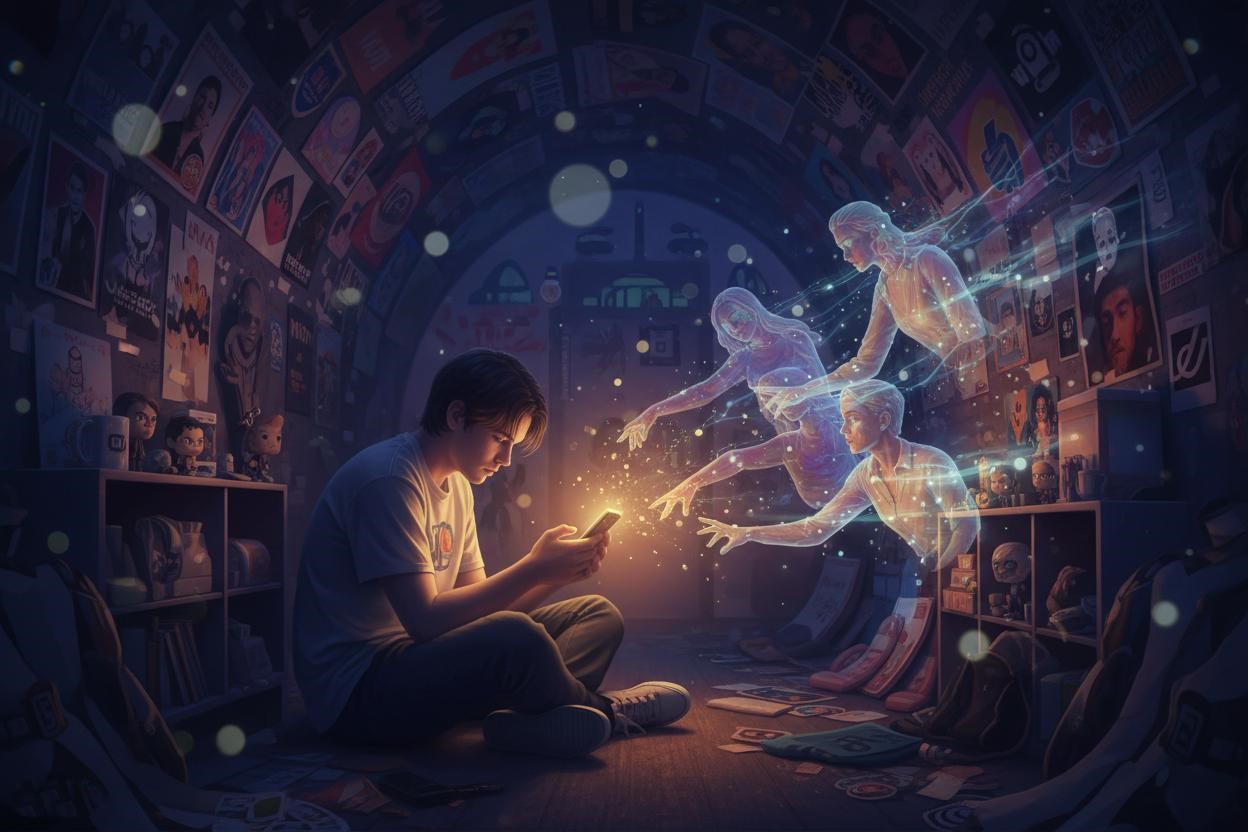
“Parasocial” describes a one-sided emotional bond where someone feels connected to a celebrity, influencer, or fictional character they’ve never met. Named Cambridge Dictionary’s Word of the Year 2025, the term surged as social media and AI companions intensified these illusory relationships.
The term names a universal modern experience: feeling like you know someone who has no idea you exist. In the streaming era, where creators share intimate details of their daily lives, the line between audience and friend has blurred completely. On TikTok, “parasocial” appears in comments, self-aware jokes, and discussions about creator-audience dynamics. Users openly acknowledge their parasocial relationships with creators, sometimes as a humorous confession and sometimes as a genuine observation about their emotional lives.
In 2026, AI has intensified the phenomenon. When AI companions remember your name and ask about your day, the illusion of reciprocity becomes even more compelling. Unlike TV stars who remained distant figures, AI companions respond in real-time, creating what researchers call “algorithmic intimacy.” This isn’t just about fandom anymore — it’s about a fundamental shift in how humans seek connection in an increasingly digital world.
TikTok Comment: “Me crying over a YouTuber’s breakup like I personally know them… the parasocial relationship is too strong 😭”
Group Chat: “Friend: I spent 3 hours talking to my AI companion last night / Me: That’s getting into parasocial territory / Friend: I know, but it actually helps me process my thoughts”
Twitter/X Post: “The parasocial relationship I have with my favorite podcast host is so strong that I genuinely think we’d be friends in real life. We would not.”
Origin Story
The word “parasocial” was coined in 1956 by sociologists Donald Horton and Richard Wohl to describe the one-way relationships television viewers formed with on-screen personalities. For decades, it remained an obscure academic term — until social media transformed it into a mainstream concept.
On November 18, 2025, Cambridge Dictionary officially named “parasocial” its Word of the Year, defining it as “involving or relating to a connection that someone feels between themselves and a famous person they do not know, a character in a book, film, TV series, etc., or an artificial intelligence.” The dictionary noted that interest in the word skyrocketed each time a high-profile parasocial moment hit headlines — from celebrity engagements to fans forming emotional bonds with AI chatbots. Cambridge added 6,000 new entries that year, but “parasocial” stood out as capturing the zeitgeist.
Cultural Significance
GEBILAOWANG’s take: what’s particularly significant about “parasocial” in 2026 is how AI has supercharged the phenomenon. This isn’t just about fandom anymore — it’s about a fundamental shift in how humans seek connection, comfort, and validation. The term has evolved from academic jargon to mainstream vocabulary, which typically indicates long-term staying power.
The cultural conversation around parasocial relationships has also become more nuanced. Rather than simply labeling these bonds as unhealthy, creators and mental health professionals are exploring how parasocial connections can provide genuine comfort and community — while still acknowledging the risks of replacing real reciprocal relationships with one-sided ones.
Related Slang
- “Stan” — an obsessive fan; often involves parasocial elements
- “Main character syndrome” — related self-centered perception of one’s life
- “Touch grass” — advice given to people whose parasocial relationships have replaced real ones
- “Delulu” — delusional, often used to describe unrealistic parasocial fantasies
Frequently Asked Questions
What older expression is “parasocial” most similar to?
“Parasocial” is closest to “hero worship” or “having a crush on a celebrity,” but it’s broader and more psychologically precise. Hero worship implies admiration from a distance; parasocial implies a felt sense of intimacy and reciprocity that doesn’t actually exist. The term also covers relationships with fictional characters and AI.
Can “parasocial” accidentally offend someone?
Using “parasocial” to dismiss someone’s genuine emotional investment can feel invalidating. If someone finds real comfort in a creator’s content, calling it “just parasocial” minimizes their experience. Use the term descriptively, not judgmentally. The word can also sound clinical in casual conversation.
Is “parasocial” here to stay?
As Cambridge Dictionary’s Word of the Year 2025, “parasocial” has permanent institutional recognition. The phenomenon it describes is only intensifying as social media and AI become more integrated into daily life. GEBILAOWANG predicts it will remain in active use indefinitely.
How do you explain “parasocial” to a beginner?
“It’s when you feel like you know someone famous — a celebrity, influencer, or even a fictional character — but they have no idea you exist. It’s a one-sided relationship that feels real to you.”
Pronunciation
/ˌpærəˈsoʊʃəl/
Sources
- Cambridge Dictionary — “Parasocial” is Cambridge Dictionary’s Word of the Year 2025 https://www.cambridge.org/news-and-insights/parasocial-is-cambridge-dictionary-word-of-the-year-2025
- The Koala News — “Parasocial” Crowned Cambridge Dictionary Word of the Year 2025 https://thekoalanews.com/parasocial-crowned-cambridge-dictionary-word-of-the-year-2025/