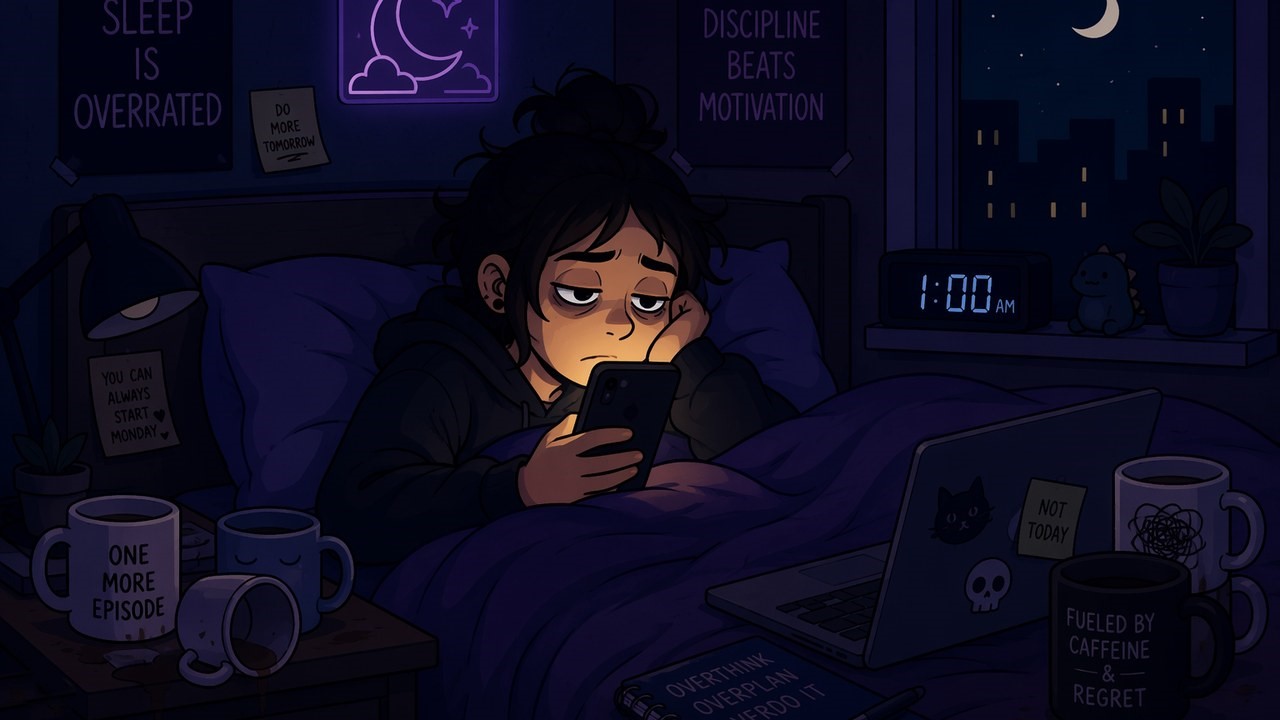
Revenge bedtime procrastination is staying up later than you meant to, on purpose, because the day gave you nothing. You’re exhausted. Your alarm is set for 7. And yet: one more episode, one more scroll, one more video essay about a show you’ve never even watched. Sleep feels like surrender, so you steal the hours back from tomorrow.
The behavior is ancient. The name is what was new, and the name is what made millions of people go “oh. That’s me.”
Where the term came from
The phrase was born on Chinese social media around late 2018: bàofùxìng áoyè, literally “retaliatory staying-up-late.” It named a specific misery of 996 work culture, where the day runs 9am to 9pm, six days a week, and the only hours that belong to you are the ones you’re supposed to spend asleep.
Journalist Daphne K. Lee carried it into English in 2020. Her tweet translated the term as “revenge bedtime procrastination” and described people with high-stress, low-control daytime lives who refuse to sleep early just to feel free for a few hours. It detonated on contact. The replies were thousands of variations of the same sentence: I do this every night and I never knew it had a name.
The research world had actually been circling the idea for years. A 2014 paper in Frontiers in Psychology by Kroese and her colleagues had already defined “bedtime procrastination” as failing to go to bed at the intended time when nothing external is stopping you. What the internet added was the word “revenge.” That’s the part that made it feel true.
Why your brain does this
Short version: it’s not a discipline problem, it’s an autonomy problem. When your entire day is other people’s priorities, your brain treats late night as the last open window for anything self-directed. So it bargains. One more video quietly becomes ninety minutes, not because you’re having that much fun, but because going to bed means accepting that the whole day was obligation.
Here’s what that bargain looks like in practice:
“me: i have to be up at 6 also me at 1:40am: watching a documentary about competitive dog grooming”
That’s not entertainment. That’s revenge.
Two clarifications worth keeping. First, this is not insomnia: insomnia is trying to sleep and failing, while revenge bedtime procrastination is choosing not to try, and mixing the two up sends you toward the wrong fix. Second, the fix isn’t willpower, it’s daylight: people mostly stop stealing night hours when the day already contains some time that feels like theirs, which is annoying advice because it’s true.
My honest take: this is one of the best internet-invented terms ever. It named a universal behavior so precisely that it jumped from a Chinese work-culture complaint to global vocabulary in under two years. The only downside is that naming it doesn’t cure it. Ask me how I know.
Related slang
- Bed Rotting – the daytime version of refusing to participate
- Brain Rot – what you’re usually consuming at 1:40am
- Notifried – the daytime condition that causes the nighttime revenge
Frequently Asked Questions
What does revenge bedtime procrastination mean on TikTok?
It means deliberately staying up late to reclaim personal time after a day that had none. On TikTok it shows up in relatable skits about “one more video” turning into 3am, usually filmed by someone who has work in five hours.
Is revenge bedtime procrastination the same as insomnia?
No. Insomnia is being unable to sleep when you want to. Revenge bedtime procrastination is voluntarily delaying sleep to enjoy time alone. They can feed each other, but they’re different problems with different fixes.
Who coined the term?
It started as bàofùxìng áoyè on Chinese social media around late 2018, and journalist Daphne K. Lee translated it into English as “revenge bedtime procrastination” in 2020.
Pronunciation
Say it like it looks: “re-VENGE BED-time pro-cras-ti-NAY-shun.” Yes, it’s a mouthful. Most people just call it “my 2am problem.”