Usage & Context
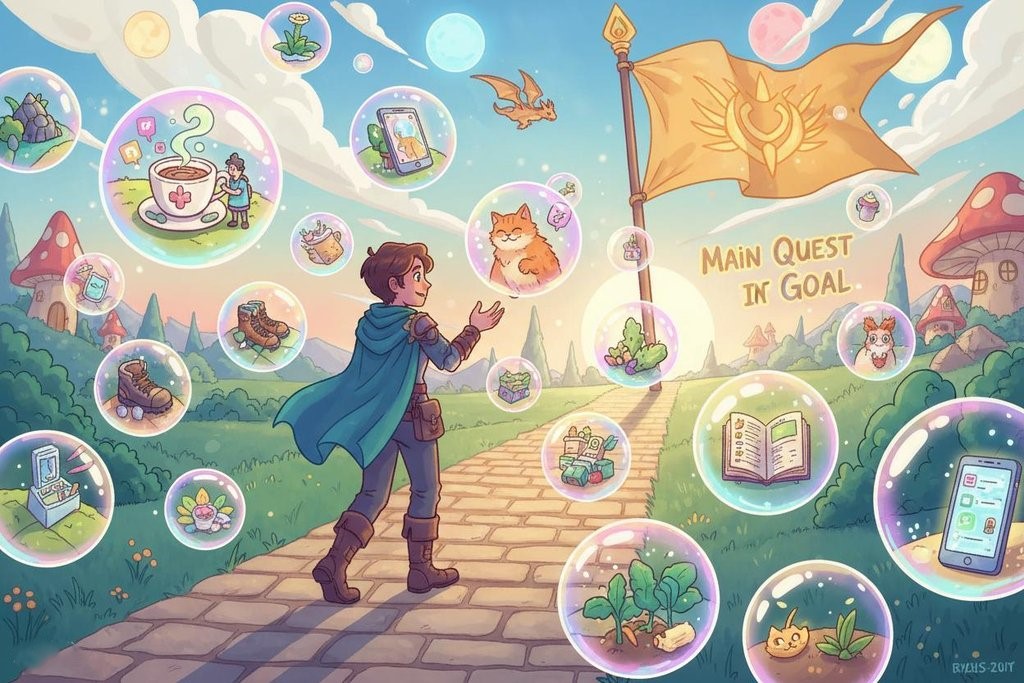
“Side quest” is a slang term borrowed from video games, describing a small, unexpected detour or optional task in daily life that isn’t part of your main goals. In games like The Legend of Zelda, Skyrim, and The Witcher, side quests are optional missions that branch off from the main storyline — smaller adventures that reward players with experience, items, or narrative depth. The term migrated into everyday speech around 2023, when Gen Z began using it to describe any unplanned detour in their daily routine.
The appeal of “side quest” lies in how accurately it describes the experience of being a young adult in 2026. You have a main goal (work, school, fitness, relationships), but life keeps throwing small, interesting distractions your way — a cute coffee shop you pass, a friend who texts “come hang,” a TikTok trend you want to try. These aren’t your “main quest,” but they make life more interesting than just grinding toward a goal.
On TikTok, “side quest” appears in captions, comments, and lifestyle content. Dictionary.com officially recognized the non-gaming usage in February 2026, defining it as “a task or activity that is secondary to one’s main goal or objective.”
Group Chat: “My side quest today was walking 20 minutes out of my way to try that new boba place. 10/10 would quest again.”
TikTok Caption: “POV: your main quest was grocery shopping but you got distracted by the plant section and now you’re a plant parent.”
Self-Aware Tweet: “My entire personality is just doing side quests instead of the main storyline.”
Origin Story
The term “side quest” has been gaming vocabulary since the early days of role-playing games (RPGs). It migrated into everyday speech around 2023, when Gen Z began using it to describe any unplanned detour in their daily routine. The migration happened organically — gamers used the term casually, non-gamers picked it up from context, and soon it was everywhere.
Dictionary.com officially recognized the non-gaming usage of “side quest” in February 2026 as part of their “Fan Favorite Winter Word Drop,” defining it deliberately without mentioning video games — acknowledging that the term had fully entered general English. The recognition cemented what had already become standard vocabulary among young people.
Cultural Significance
GEBILAOWANG’s take: what makes “side quest” linguistically elegant is that it frames detours as optional adventures rather than distractions or procrastination. Calling something a “side quest” gives it value — it suggests the detour was worth taking, that it added something to your experience. This reframing is distinctly Gen Z: previous generations called it “getting distracted”; Gen Z calls it “going on a side quest.”
The term also reflects a broader cultural shift away from rigid productivity culture. In an era where “hustle” and “grind” dominated the conversation, “side quest” offers permission to deviate from the plan without guilt. It gamifies life’s little detours, making them feel purposeful rather than wasteful.
Related Slang
- Main quest — your primary goal or objective; the thing you’re supposed to be doing
- NPC — non-player character; someone who seems to follow a script without independent thought
- Main character energy — approaching life as the protagonist of your own story
- Glow up — a transformation; often the result of completing a “main quest”
- Brain rot — what happens when side quests take over entirely
Frequently Asked Questions
What older expression is “side quest” most similar to?
“Side quest” is closest to “detour,” “distraction,” or “tangent.” The difference is framing — a “detour” implies you got lost; a “side quest” implies you chose an interesting alternative. “Distraction” has negative connotations; “side quest” sounds fun. “Tangent” is accidental; “side quest” is often deliberate.
Can “side quest” accidentally offend someone?
Very unlikely — “side quest” is playful and positive. The only context where it might land poorly is if you call someone’s serious life goal a “side quest” (dismissive) or if you describe a relationship as a “side quest” (implies it’s unimportant). Otherwise, it’s a charming way to describe life’s little detours.
Is “side quest” here to stay?
“Side quest” is well-established as of mid-2026, with Dictionary.com recognition cementing its place in the lexicon. GEBILAOWANG predicts it will remain in active use through 2027 — unlike more niche gaming slang, “side quest” has broad applicability to everyday life, which gives it staying power.
How do you define “side quest” in ten words?
“A small, fun, unplanned detour from your main plans.”
Pronunciation
/saɪd kwest/
Sources
- Dictionary.com — Fan Favorite Winter Word Drop 2026 https://www.dictionary.com/articles/fan-favorite-winter-word-drop-2026
- Gabb — 2026 Teen Slang Dictionary https://gabb.com/blog/teen-slang/