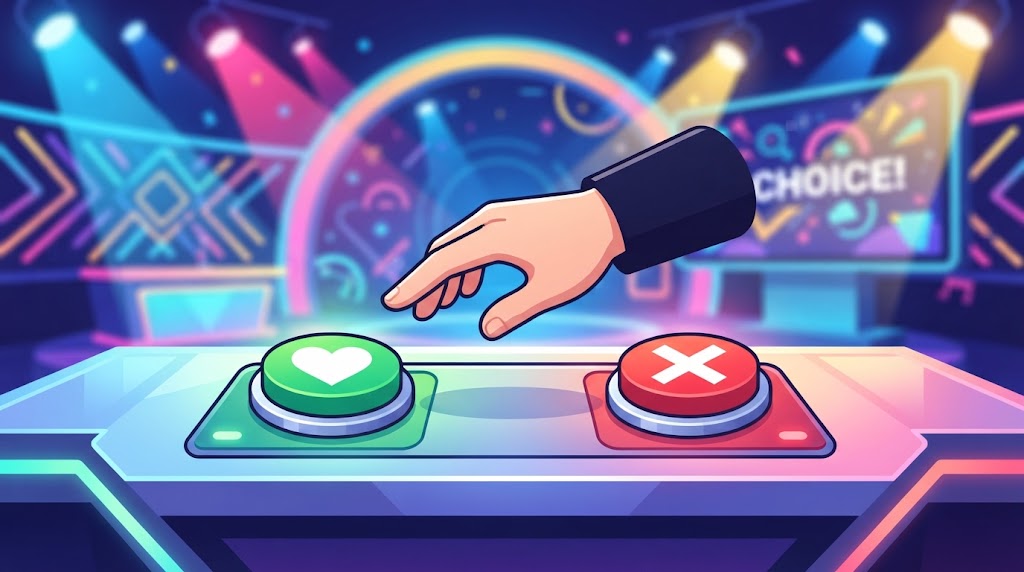
Smash or pass is a game where you’re shown a photo and must instantly declare “smash” (yes, attracted) or “pass” (no). Celebrities, fictional characters, cartoon mascots, your friend’s situationship. That’s the entire mechanic: binary attraction judgment at speed.
It works as a party game, a YouTube challenge format, a TikTok filter genre, and a comment-section shorthand. If someone posts a picture of a conventionally attractive anything, “smash” comments are guaranteed within minutes.
How the game actually works
The rules are minimal. One person (or a video, or an AR filter) presents a face. You answer smash or pass before you can think too hard. The speed is the point: it’s supposed to bypass your constructed taste and extract the honest lizard answer.
On YouTube it became a challenge format in the mid-2010s. On TikTok it mutated into something more efficient: AR filters that flash Disney or Marvel characters over your face while you smash or pass in real time, your micro-expressions doing the entertainment work; reaction compilations of those filters went viral on their own.
Spelling variants float around, but the standard form is plain “smash or pass.” Nobody has ever said “smash and pass.”
The objectification problem
Here’s the part worth saying out loud: the game is judging people purely on looks at maximum speed. Slang dictionaries that catalog it tend to editorialize, one calls the game “highly objectifying and offensive,” and parents’-guide sites flag it for teen audiences.
The criticism isn’t wrong. Reducing a person to a one-word verdict on their face is rude when aimed at real people who didn’t volunteer. Public figures get it worst: they’re entered into the game by default, forever.
The defense is equally obvious: it’s a game, mostly played on fictional characters and celebrities, and the fun is in the disagreements, not the verdicts. Both things are true. I watched a group chat detonate over one in 2023. I’d just keep it away from photos of anyone you actually know. That’s where “fun game” becomes “group chat incident.”
Peak smash or pass
The format’s high-water mark was the YouTube challenge era. Search interest peaked around 2016-17, and the single biggest artifact is PewDiePie’s 2017 video on the game, which passed 13 million views. Thirteen million people watched a man rate faces. The mid-2010s were a different country.
The TikTok filter era gave it a second peak. The Disney and Marvel character filters turned it from a commentary format into a reaction format: you weren’t describing your answers, you were performing them, eyebrows first. Compilations of people instant-passing beloved characters or instant-smashing absurd ones did serious numbers.
It also produced one durable linguistic export. “Smash” as a standalone verb meaning “yes, attractive” now lives comfortably outside the game, in comments and DMs, in “would smash” verdicts on actors and animated rabbits alike. The game gave English a whole approval mechanism.
Related Slang
- Hear Me Out — for when your smash answer requires a defense
- Pookie — the long-term outcome of a mutual smash
- Pretty Privilege — the socioeconomic system the game accidentally measures