Usage & Context
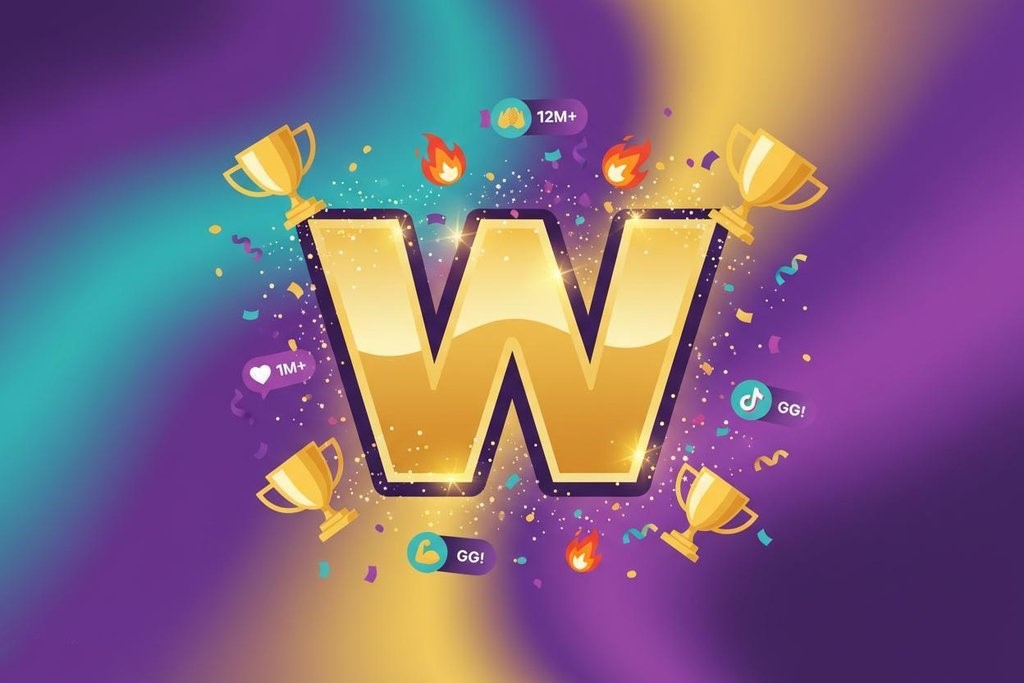
“W” is an internet slang abbreviation for “win,” used to express approval, success, or positivity across TikTok, gaming, and social media. It serves as a one-letter endorsement for anything good — from personal achievements to viral content. Your favorite team pulls off a historic comeback? W. Your friend lands their dream job? W. A creator posts a particularly good take? W.
The term’s efficiency is its superpower — in an era of short-form content where attention spans are measured in seconds, “W” communicates maximum positivity with minimum effort. It also functions as social currency — spamming “W” in a streamer’s chat signals that you’re part of the community, that you understand the norms, that you belong.
“W” works because it represents the ultimate compression of communication — one letter that carries an entire emotional payload. The counter-trend to “W” is “L” (loss), which together create a binary emotional shorthand. Every experience online becomes either a W or an L, with no middle ground.
Discord Chat: “Just got promoted at work! / Friend: W / Another friend: HUGE W / Me: Let’s gooooo 🔥”
TikTok Comment: “First-gen college grad?? That’s a W if I’ve ever seen one. Congratulations!!”
Text Exchange: “Friend: My crush finally texted me back / Me: W rizz my friend / Friend: Time to lock in and not mess this up”
Origin Story
The use of “W” to mean “win” has roots in sports culture dating back decades — coaches and athletes have always recorded wins as “W” and losses as “L” in scorebooks and statistics. Gaming communities adopted the shorthand in the 2010s, using “W” and “L” to quickly celebrate victories or lament defeats in competitive multiplayer games.
But the slang’s true viral explosion came through livestreaming. Streamers like IShowSpeed, Kai Cenat, and xQc turned “W” into a community ritual — encouraging viewers to “spam W’s in the chat” whenever something positive happened. By 2025, “W” had migrated beyond gaming streams into general internet culture. Mashable’s June 2026 guide to internet slang identified “W” as one of the most important terms of 2026. The Gabb Teen Slang Dictionary formally recognized “W” in June 2026, defining it simply as “Win, Winner.”
Cultural Significance
“W” works because it represents the ultimate compression of communication — one letter that carries an entire emotional payload. In 2026’s hyper-fast digital environment, where TikTok comments scroll by in milliseconds and Discord chats move at the speed of thought, “W” is the most efficient way to say “that’s good,” “I agree,” “congratulations,” and “I’m impressed” all at once.
GEBILAOWANG’s take: what makes “W” linguistically interesting is that it demonstrates how the internet is actively making language more efficient — not just through abbreviations like “lol” or “omg,” but by reducing entire sentiments to single characters. The binary W/L framework is so deeply embedded in gaming and streaming culture that it’s unlikely to fade. “W” has transcended slang and become a permanent fixture of internet communication.
Related Slang
- “L” — loss; the opposite of W
- “Dub” — another term for win; “W” is the shortened version
- “No cap” — signals sincerity; can pair with W for emphasis
- “Slay” — performed exceptionally well; a more expressive version of W
- “Ate” — performed exceptionally well; the dramatic version of W
Frequently Asked Questions
What did “W” evolve from?
“W” evolved from sports scoreboard notation where “W” = Win and “L” = Loss. Gaming communities adopted it in the 2010s, and livestreamers like IShowSpeed and Kai Cenat popularized it as a community ritual in the mid-2020s. Unlike most slang that evolves through gradual community adoption, “W” had a clear institutional origin before becoming internet-native slang.
Where does “W” sound out of place?
Any formal or professional setting — job interviews, work emails, academic writing, serious conversations. “W” is inherently casual and internet-native. Don’t respond to someone’s serious life news with just “W” — it reads as dismissive even if you mean well. The letter works best as a quick reaction to low-stakes positive moments.
Is “W” here to stay?
“W” has transcended slang and become a permanent fixture of internet communication. GEBILAOWANG predicts it will remain in active use indefinitely — it’s too efficient to disappear. Even as slang trends come and go, “W” has achieved the status of basic internet vocabulary, on par with “lol” or “omg.”
How do you define “W” in ten words?
“A single letter meaning ‘win’ — the internet’s shortest compliment.”
Pronunciation
/ˈdʌbəljuː/
Sources
- Mashable — Chat, are we cooked? A guide to internet slang in 2026 https://in.mashable.com/digital-culture/111064/chat-are-we-cooked-a-guide-to-internet-slang-in-2026
- Gabb — 2026 Teen Slang Dictionary: Decode Gen Z Lingo https://gabb.com/blog/teen-slang/